Overview
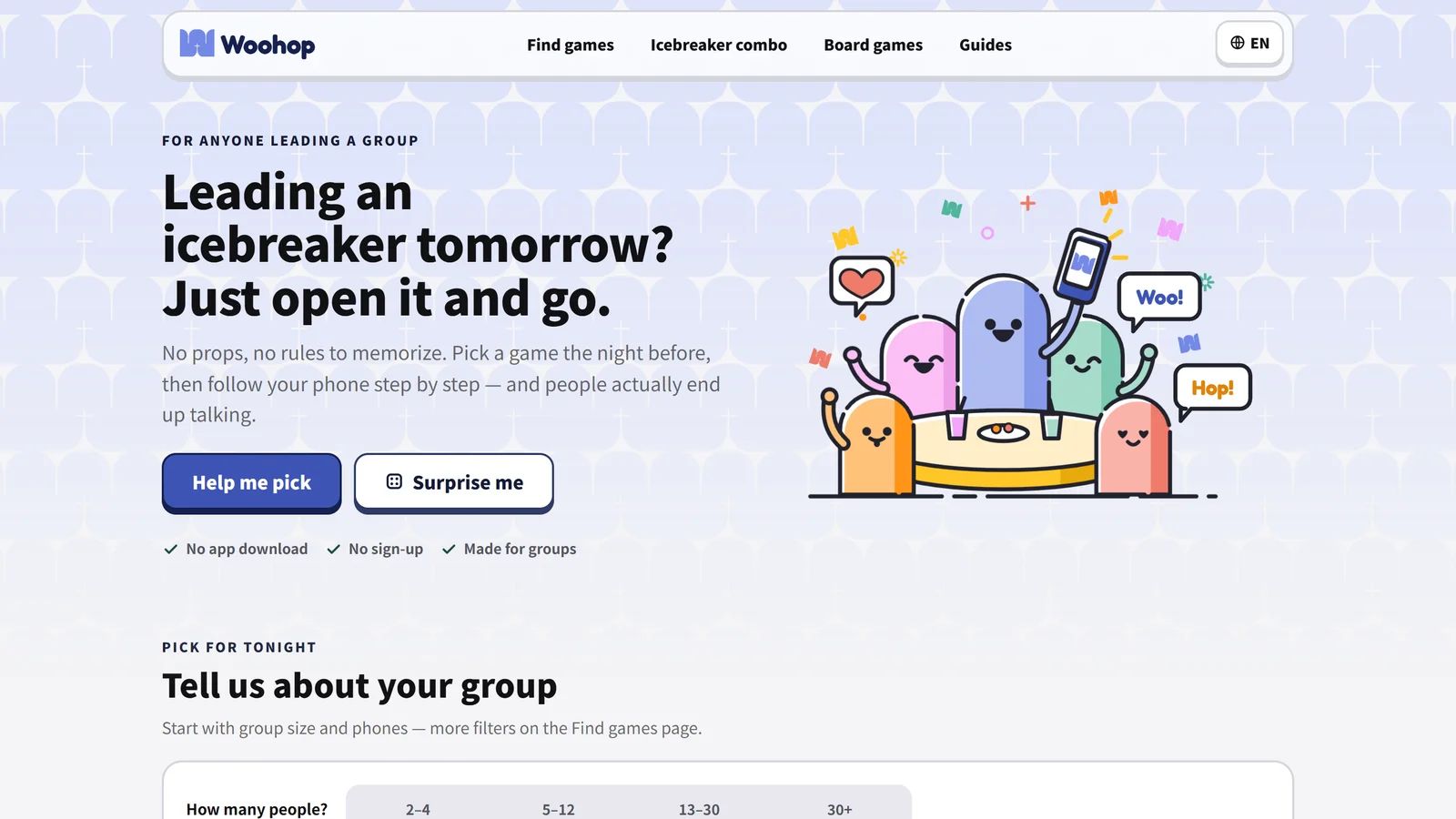
Woohop is an icebreaker toolkit for anyone leading a group. No props, no rules to memorise: pick a game the night before, then follow your phone step by step on the day.
It started as a series of party games you play right in the browser. Once the games had launched and found users, I redesigned it into Woohop. From planning, design and development to analytics and social media after launch, I do all of it myself, working with AI.
My role: a one-person product team
| Area | What I did |
|---|---|
| Product planning | Set a two-year growth goal broken into quarterly checkpoints; plan work weekly and use data at each checkpoint to decide what comes next |
| UI/UX design | Brand, illustration style, the home page and every game’s interface |
| Development | Built the games and multiplayer rooms with Claude Code, in 8 languages |
| Analytics | Connected GA4 to generate weekly reports, alongside Search Console for search performance |
| Social media | Run the Threads account, 5–6 posts a week, through a scheduling tool I built |
Version 1: many small games first
The original problem was simple:
- Hosting takes prep: for parties and icebreakers, hosts have to look up rules, memorise scripts and prepare props.
- Existing tools ask too much: many games require an app download or an account, and nobody wants to wait around.
So the first version was a set of standalone games. Each one launches on its own, can be found in search on its own, and quickly shows whether people actually play it. The first one took just 4 evenings.
The first games to launch:
| Product | How it plays |
|---|---|
| This or That | Answer a few questions, get grouped and see what you have in common |
| Happiness Bingo | Bingo where you find people, not numbers |
| Time Bomb | Pass one phone around; whoever holds it when it goes off loses |
| Buzzer quiz | Scan a QR code to join and race to answer |
| Avalon voice host | Reads the host’s lines aloud automatically |
| Happiness Simulator | A big screen plus everyone’s phone (read case) |
Why redesign
As the number of games grew, the problem shifted from “there’s no tool” to “which one do I pick?”
The people who actually open the site are usually leaders running an event tomorrow. They don’t care about a list of games. They want to know:
- How many of us are there? Does everyone have a phone? Which game fits?
- One game isn’t enough. How do I order a warm-up and a get-to-know-you?
- It’s my first time leading. What if it falls flat?
The old home page was just a row of games, leaving all of these questions to the user. So the redesign turned a game collection into a toolkit for leaders, under a new name, Woohop: easier to remember and more like a party.
What changed
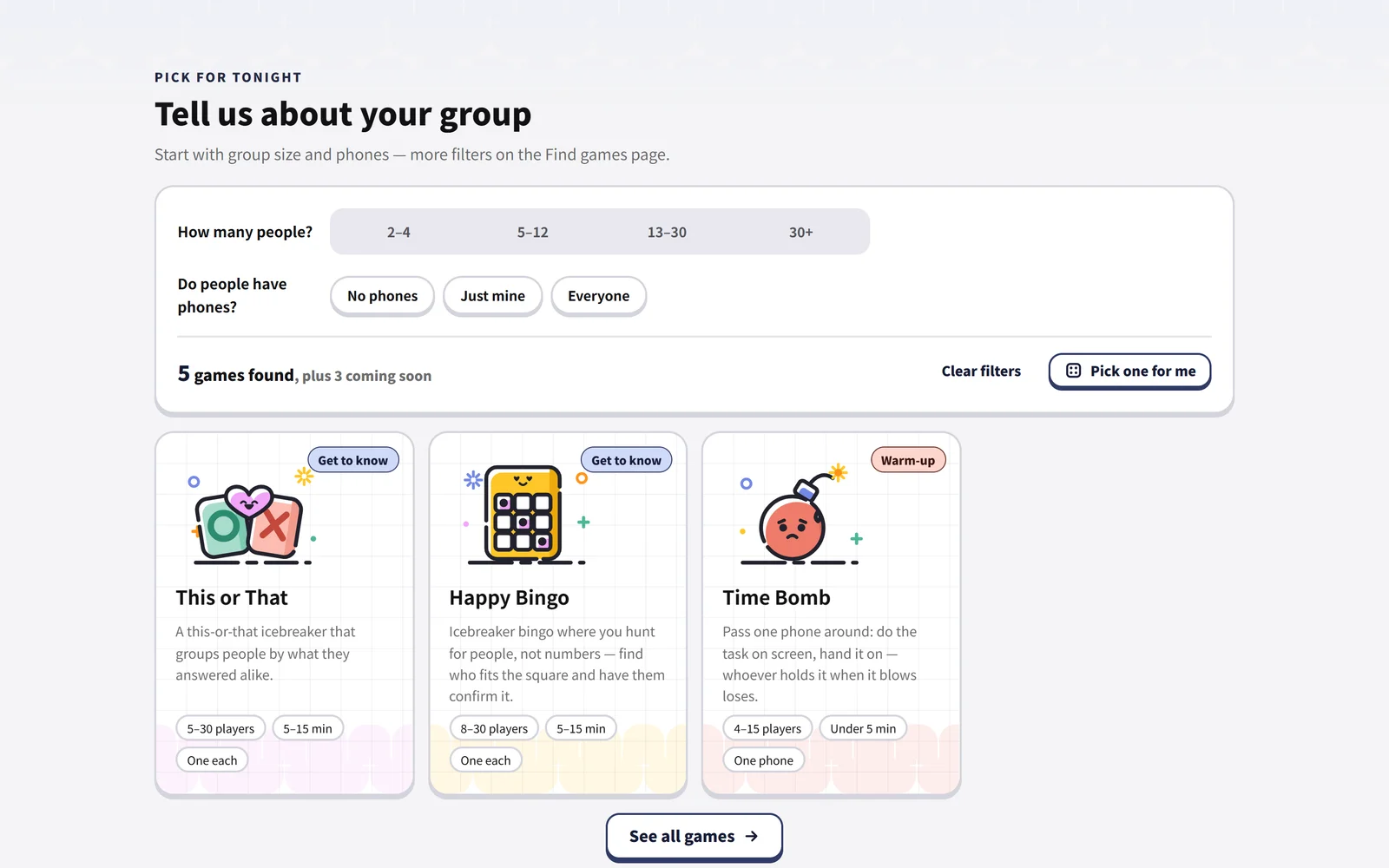
1. Help me pick: start with the group
The home page asks just two questions: how many people, and whether they have phones. Matching games appear right away, each card labelled with its purpose (warm-up or get to know each other), group size, length and phone needs. Anyone who doesn’t want to choose can hit “Surprise me”.
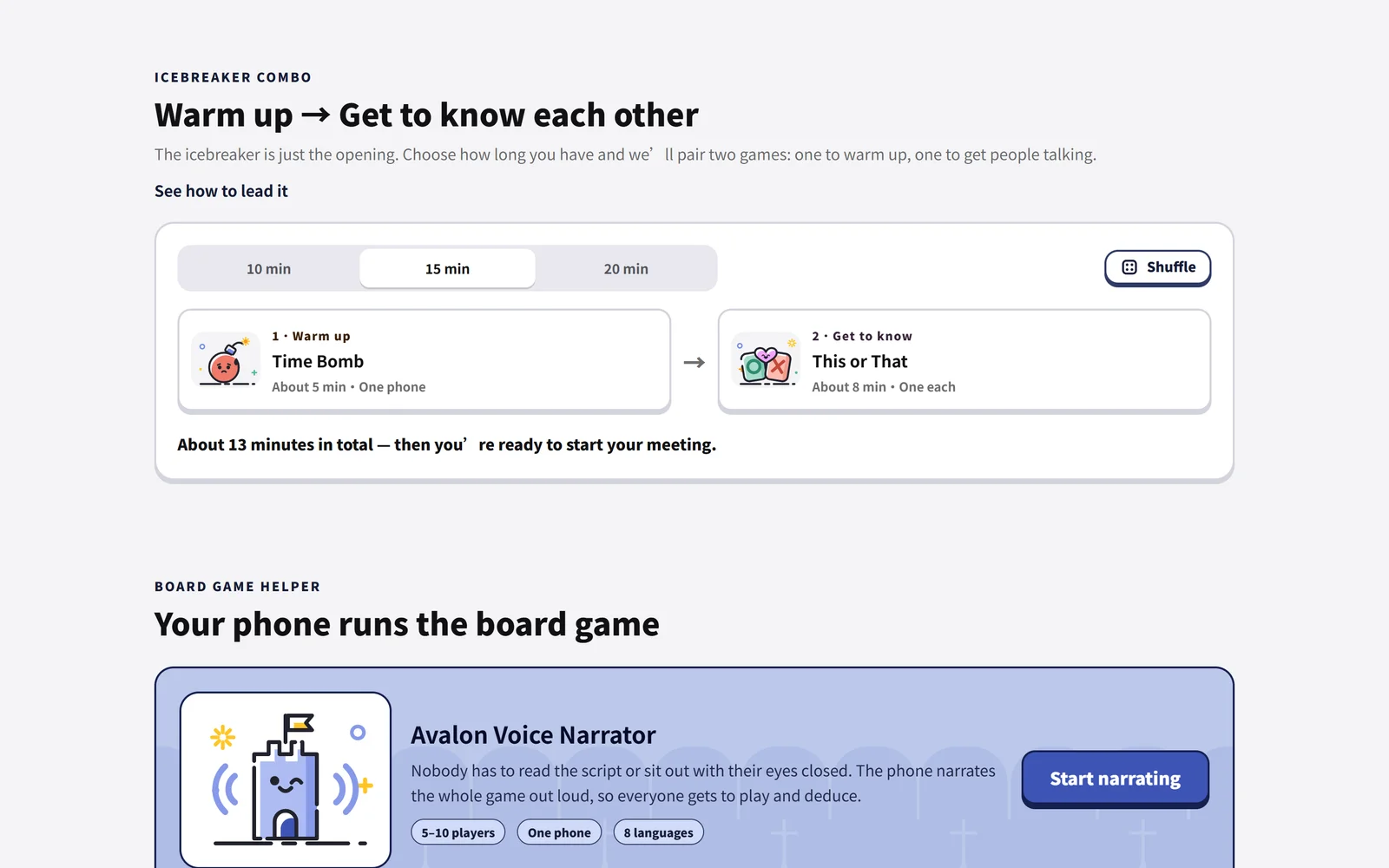
2. Icebreaker combo: a ready-made flow
An icebreaker is only the start of a gathering. Choose 10, 15 or 20 minutes and Woohop pairs a warm-up with a get-to-know-you game and adds up the total time, so you can move straight into the main event.
3. Organised by situation, not by game type
The Avalon voice host lives under “Board games”, and Happiness Simulator under its own small-group section. Leaders come in through their own situation and find the right tool fast.
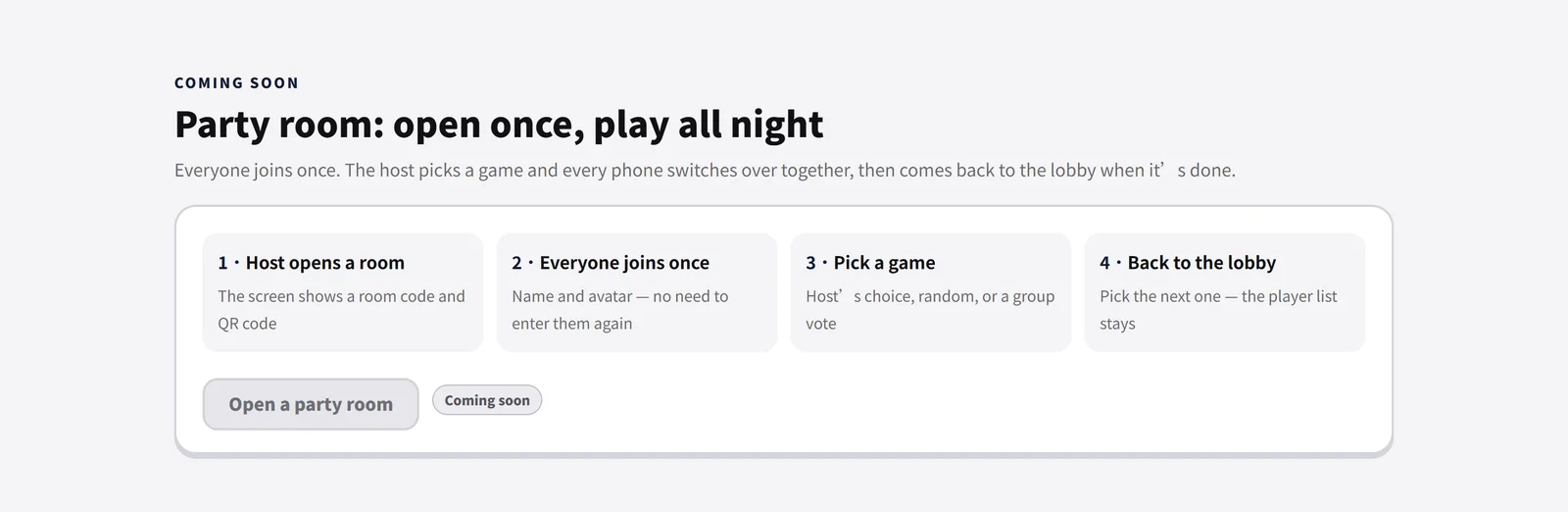
4. Next up: party room and guides
- Party room: everyone joins once. When the host picks a game, every phone switches over together and returns to the lobby afterwards, with no rescanning for each game.
- Guides: a sample 15-minute flow for first-time leaders and lines to rescue a quiet room, so people without experience feel ready to lead.
Key decisions
1. Validate with small products, then combine them
Building a big platform first makes it hard to know what people want. Shipping small games first showed that “This or That” was the favourite and that leaders were the main users, and the redesign was built on those findings.
2. Only two filters up front
Group size and phones are the two things people can answer fastest on the spot, and they decide the most. Other filters live on the Find games page so the home page stays simple.
3. Fewer settings, faster starts
Play-testing with friends and groups showed that people had fun, but too many settings before starting killed the mood. Settings were cut to the minimum so a game starts almost as soon as it opens. The party room follows the same idea: joining happens only once.
4. Eight languages from day one
Icebreakers are needed everywhere. With AI, translation became cheap, so every new feature in the redesign also ships in 8 languages.
After launch: growing with data and social media
1. Watching the right numbers
The GA4 sources showed that every room a host opens brings in 4–5 players on average. Total users get inflated by big events, which hides whether the product is really growing. So I switched to three metrics, checked every week:
- Hosts: people who open a room or start a game each week, the ones choosing Woohop themselves
- Google search users: whether more people are finding Woohop on their own
- People from Threads: whether social posts actually bring in users
2. Quality over speed
Shipping too fast with thin content early on cost search rankings. Since then, a game only launches with real gameplay and leading instructions, and long-form guides are written in Traditional Chinese only rather than translated just to add languages.
3. Running Threads: 5–6 posts a week, published automatically
Once a week I review the whole week’s posts: new games, discussion prompts, screen recordings and behind-the-scenes posts in rotation. A scheduling tool I built publishes them on time, and every link carries tracking parameters so GA4 shows how many people each post brings in. Posting frequency has its own checkpoint: if average views per post drop noticeably as volume goes up, the schedule goes back to what it was.
4. AI as a team: development, social and analytics
To cover all of this alone, I split the work across three AI assistants: development handles new games and bug fixes, social drafts posts and graphics, and analytics writes the weekly report. Each reports its results to a Notion board, while I review, play-test and make the calls.
Most popular: This or That
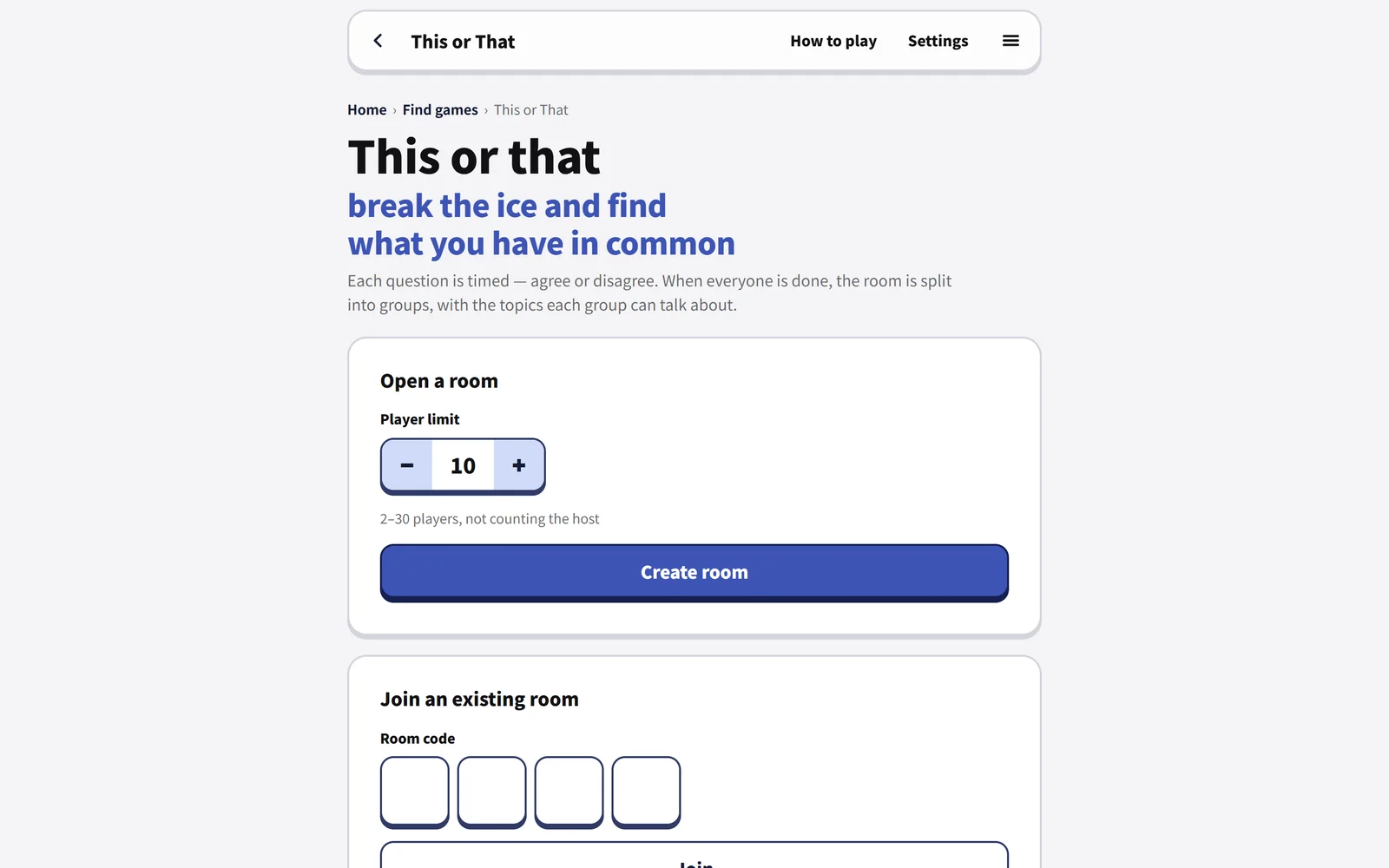
Everyone answers a few either-or questions, like “cats or dogs”. The game then groups people with similar tastes and lists what they have in common, so people get to know each other quickly and find someone to talk to.
Results
- 4.4k+ users since launch, in 8 languages
- 3.1k+ monthly active users, nearly 3x the previous month
- Redesigned from a game collection into the Woohop icebreaker toolkit, where two questions on the home page find the right game
- Built, single-handed, the full loop from product planning and development to tracking and social posting